Frances Thompson: the trans woman who testified before Congress
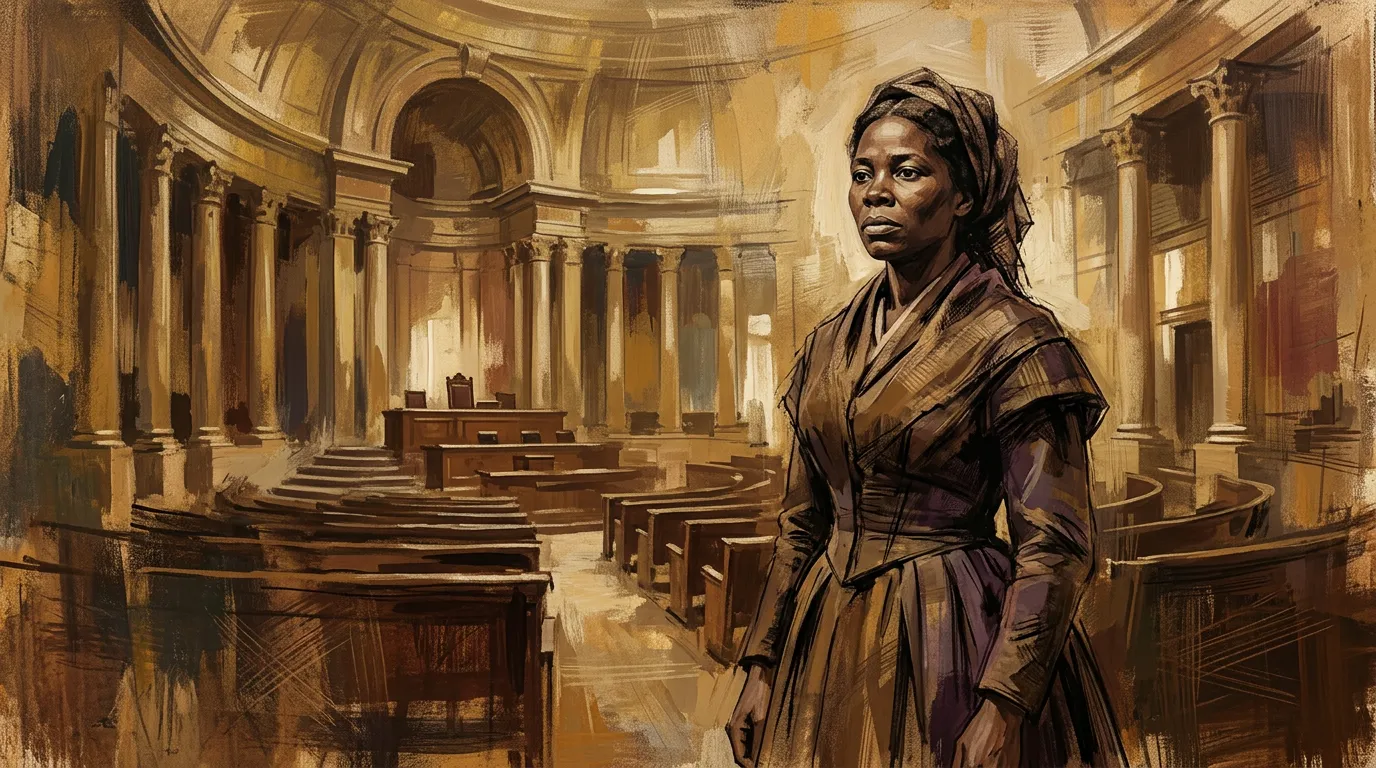
Frances Thompson was the first known transgender person to testify before the United States Congress. A Black trans woman, formerly enslaved, and a survivor of sexual violence during the Memphis massacre of 1866, her testimony helped change the course of American history. Ten years later, she was arrested, humiliated, and destroyed for the same identity she had lived openly for nearly thirty years.
Early years and enslavement
Frances Thompson was born around 1840 in Maryland [1][4]. She was enslaved by the family of Robert Walker, a landowner of Virginia origin, and was brought to Memphis as a child [5]. From childhood, Thompson lived as a woman. The Walker family recognized her as a girl and allowed her to wear women’s clothing [5].
Thompson suffered from a physical disability — a tumor on her foot that caused difficulty walking and required her to use crutches [5]. Despite these limitations, after emancipation she built an independent life in Memphis, renting a house on Gayoso Street in the predominantly Black neighborhood known as “Hell’s Half-Acre” [5]. She worked as a seamstress, laundress, and housekeeper, earning the respect of the community.
Memphis before the massacre
Post-Civil War Memphis was a city in turmoil. The Black population had grown rapidly with the arrival of people freed from slavery and Union Army veterans. This growth generated deep tensions with the white population, particularly with the city police and residents of Irish origin, who saw the emancipated Black community as a threat to their social and economic status [6][8].
Thompson lived in this precarious context but had built a network of relationships in the community. She shared her home with Lucy Smith, a Black girl of about sixteen years old [6]. Beyond her work as a seamstress, Thompson also established herself as “Madame Thompson, Fortune Teller,” practicing hoodoo — an African American spiritual tradition — and creating protective sachets that she sold in the area of the old Shelby County jail [5].
The Memphis massacre
On May 1, 1866, a confrontation between white police officers and a group of Black Union Army veterans erupted into three days of systematic racial violence [1][2]. White mobs, often led or accompanied by police officers, attacked the Black community of Memphis. The toll was devastating: 46 Black people killed, dozens of women raped, and over 90 homes burned, along with churches and schools [2][6].
On Tuesday night, between one and two o’clock, seven men broke into Thompson’s home. Two of them were police officers, recognizable by the stars on their chests; they were all Irish [6][9]. They demanded that Thompson prepare dinner: eggs, ham, biscuits, and strong coffee. After eating, they demanded that Thompson and Lucy Smith have sexual relations with them.
Thompson refused. She told them they were not “that kind of women” and that they should leave [6]. One of the men struck her in the face, grabbed her by the throat, and choked her. When Lucy tried to escape through the window, another man grabbed her and threw her to the ground. The men drew their pistols and threatened to burn down the house.
All seven raped the two women. Four raped Thompson, the rest raped Lucy [6][9]. The violence lasted hours. Before leaving, the men stole $100 in banknotes belonging to Thompson, $200 belonging to another woman, three silk dresses, and the quilts that Thompson and Smith were sewing. On their way out, they declared they wanted to “burn every last damned negro” [6].
Thompson remained bedridden with a high fever for three days and was ill for two weeks [6].
Testimony before Congress
On June 1, 1866, one month after the massacre, the House of Representatives sent an investigative commission to Memphis led by Illinois Republican Elihu B. Washburne [1][4]. The commission met at the Gayoso House Hotel and heard 170 witnesses — men and women who recounted the violence they had suffered.
Frances Thompson was among the witnesses. Before the congressional commission, she recounted in detail what had happened to her and Lucy that night. Her account — lucid, precise, free of rhetorical emphasis — moved the commission members to tears [1][2].
Her testimony and that of the other survivors had an enormous political impact. Together with the New Orleans massacre that occurred the same year, the depositions helped repudiate President Andrew Johnson’s conciliatory policies toward the South and strengthen the position of Radical Republicans in Congress [2]. This led to the passage of the Reconstruction Acts, the Enforcement Acts, and the Fourteenth Amendment to the Constitution, which guaranteed citizenship and equal legal protection to all people born in the United States [2][8].
Frances Thompson is considered the first known transgender person to have testified before the United States Congress [1][2][7].
Ten years of life in Memphis
In the ten years following her testimony, Thompson continued to live openly as a woman in Memphis. Police records from the period show that she was arrested several times for fights, disorderly conduct, and for running an alleged brothel — a charge frequently used against single Black women of the era [5]. She paid modest fines, between $5 and $15, and returned to her life.
The 1870 federal census recorded her as a woman [5]. The community knew her as “Aunt Crutchie” (from her use of crutches) and as the fortune teller of Front Street [5]. For nearly thirty years, from slavery to freedom, Thompson had lived her identity without anyone formally questioning it.
The arrest of 1876
On the night of July 10, 1876, a neighbor reported Thompson to the Memphis police, claiming that she was not a woman but a man in women’s clothing [4][5]. Officer Pat McElroy arrested her.
Thompson was subjected to a forced medical examination by Dr. Joseph Nuttall and three other physicians, who declared her biologically male [5]. Thompson described herself as a person of “double sex” [1][4]. She was charged with violating the city’s public indecency ordinance — a law that criminalized so-called “cross-dressing,” which had been passed before the Civil War as part of a package of laws designed to control the public life of Black people, along with prohibitions on vagrancy and Black social gatherings [5].
The fine was $50 (equivalent to approximately $1,400 today). Thompson could not pay it. She was sentenced to 100 days of hard labor on the city’s chain gang, at a rate of 50 cents per day [5].
Public humiliation
On July 14, 1876, Thompson was photographed twice: once in men’s prisoner’s clothing, and once in women’s clothing provided by the photography studio [5]. The images were displayed in the “rogues’ gallery” of police chief Phil Athy and reproduced as engravings in a New York tabloid, then distributed to other police departments across the country.
The authorities seized her belongings. Her landlord sued for back rent; her furniture, linens, and her “Madame Thompson, Fortune Teller” sign were confiscated and sold at auction [5].
Crowds of onlookers gathered along the daily route of the chain gang to watch Thompson, ask her questions, or insult her [4][5]. The commotion was such that some of her fellow prisoners managed to take advantage of it to escape. Thompson was removed from the chain gang and finished serving her sentence at the police station, where the harassment continued.
Political exploitation
Thompson’s arrest was not merely an act of individual persecution. Southern Democrats, who for a decade had been seeking to dismantle Reconstruction and the rights of Black people, used the news to discredit her 1866 testimony [1][2]. If Thompson was a “man dressed as a woman,” they argued, then her rape accusation was a lie, and by extension, all the testimonies about the Memphis massacre were unreliable.
It was a deliberate political strategy: to delegitimize a survivor in order to delegitimize an entire civil rights movement. The logic was the same that would be used for decades against trans people: to deny their identity in order to deny their credibility, their suffering, their humanity.
Death
After her release, Thompson moved to North Memphis, severely debilitated [4][5]. Some community members, concerned about her condition, accompanied her to the hospital.
Frances Thompson died on November 1, 1876, at approximately thirty-six years of age, from dysentery in the city hospital [4][5].
A rediscovered legacy
For over a century, Frances Thompson’s story was forgotten or relegated to a footnote in Reconstruction textbooks. When she was mentioned, it was often through the distorted lens of her persecutors: the “cross-dresser” unmasked, not the woman who had challenged Congress.
Only in recent years, thanks to the work of historians and activists, has her figure been restored to the center of the narrative. Historian Hannah Rosen, in her study “Terror in the Heart of Freedom” (2009), analyzed how sexual violence during Reconstruction served as an instrument of racial and gendered terror, restoring dignity to Thompson’s testimony [8]. Organizations such as the Human Rights Campaign and the Trans History Project now recognize her as a pioneer in the history of trans and civil rights [2][7].
The story of Frances Thompson speaks to a present that is all too familiar with the dynamics of forced outing as a political weapon, the delegitimization of trans people through the denial of their identity, and the use of law as an instrument of persecution rather than protection. In 1876, it took only a neighbor and a public indecency ordinance to destroy a life. The distance from the present is narrower than we might wish to believe.
Frequently asked questions
Who was Frances Thompson?
Frances Thompson (1840-1876) was a Black trans woman and formerly enslaved person who lived in Memphis during the Reconstruction era. In 1866, she became the first known transgender person to testify before the United States Congress, recounting the violence she endured during the Memphis massacre.
What was the Memphis massacre of 1866?
The Memphis massacre was an explosion of racial violence lasting three days, from May 1 to 3, 1866, in which white mobs and police officers attacked the Black community of the city. Forty-six Black people were killed, dozens of women were raped, and homes, churches, and schools were set ablaze.
Why was Frances Thompson's testimony important?
Her testimony before the congressional committee helped repudiate President Andrew Johnson's policies and bolster Radical Reconstruction, leading to the passage of the Reconstruction Acts, the Enforcement Acts, and the Fourteenth Amendment, which guaranteed the civil rights of emancipated Black people.
How did Frances Thompson die?
In 1876, Thompson was arrested on a charge of public indecency for wearing women's clothing and sentenced to 100 days of hard labor. After her release, she fell ill and died of dysentery on November 1, 1876, at approximately 36 years of age.
Further reading
- book Terror in the Heart of Freedom (2009)