Valentina Petrillo: the athlete who made history
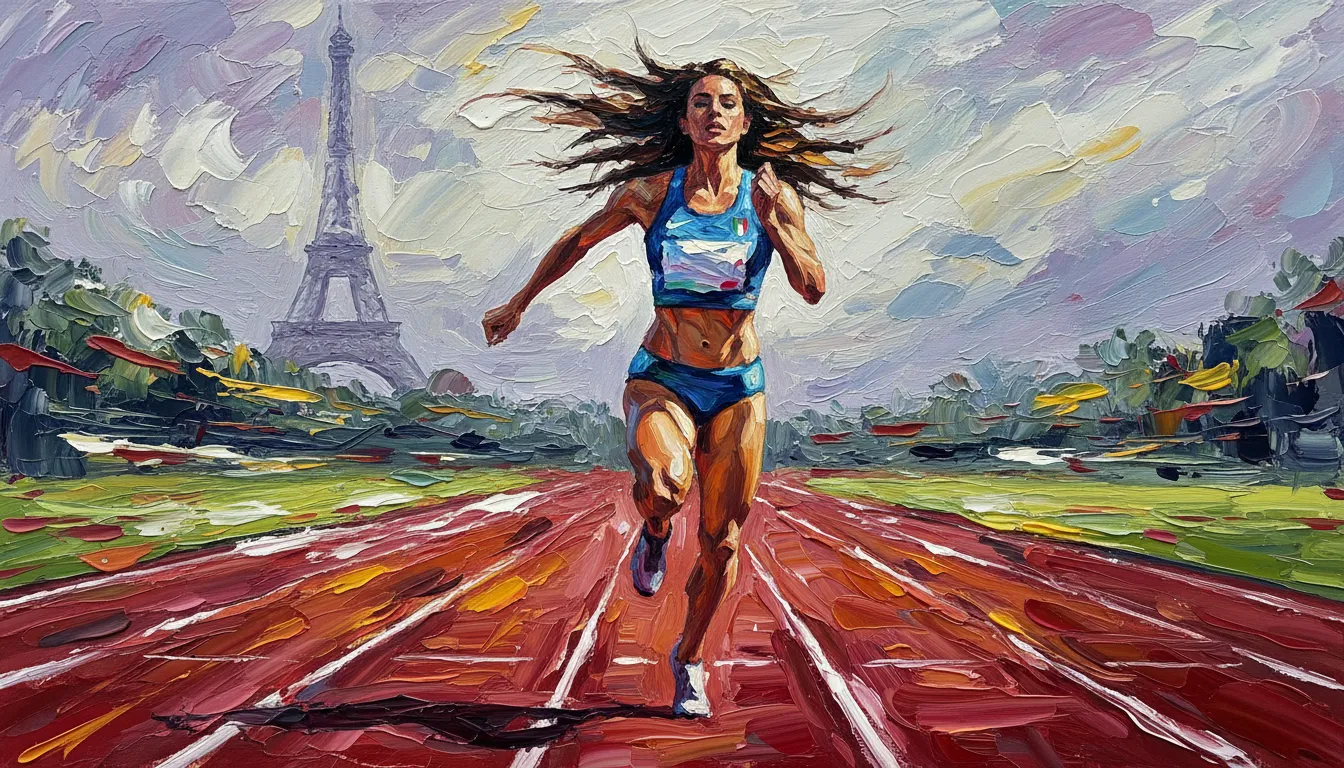
Valentina Petrillo is an Italian Paralympic athlete who has written an important page in the history of sports [1][2]. On September 2, 2024, at the Paris Paralympic Games, she became the first transgender woman to compete in an international Paralympic event [2][4], bringing into the global spotlight not only her exceptional athletic abilities but also a story of courage, resilience, and a double challenge: that of gender identity and that of visual impairment.
Childhood in Naples and the Olympic dream
Born in Naples on October 2, 1973 [1], Valentina grew up in a tough neighborhood during the 1980s. From childhood, she nurtured a great passion for athletics, a love born from watching the feats of Pietro Mennea, the legendary Italian sprinter who in 1980 won the Olympic gold medal in the 200 meters at the Moscow Games [3]. Valentina was only seven years old, but that victory left an indelible mark: she wanted to run like Mennea, she wanted to wear Italy’s national team jersey, she wanted to reach the Olympics. There was, however, a fundamental difference: even then, in her imagination, she saw herself running with a female body [3].
Running became for her a form of escape, a path to freedom from the difficulties of the neighborhood and, as she grew, from the inner tensions related to her gender identity. Sport took on an almost redemptive significance, a space where she could express strength, determination, and freedom.
Stargardt disease: when sight fades
At 14, Valentina’s life changed radically. She was diagnosed with Stargardt disease, a hereditary form of macular degeneration that affects the retina and leads to progressive loss of central vision [1][5]. It is the most common form of inherited macular dystrophy, with an incidence of approximately one in 10,000 people [5].
The diagnosis was a devastating blow for a young athlete who dreamed of running at the highest levels. As her sight progressively blurred, it became impossible to continue with athletics as before. Valentina had to temporarily leave the track and find other paths. After completing her studies in Bologna, she found a new way to express herself in sport: she joined the Italian national futsal team for visually impaired players [1], where she could continue to be part of a team and compete despite her visual disability.
Return to athletics: 11 national titles
In 2014, at age 41, Valentina decided it was time to return to her first passion: running [1]. With determination and discipline, she began training seriously for Paralympic athletics, competing in the category for visually impaired athletes.
The results came quickly. Between 2014 and 2019, competing in the men’s category (before her gender transition), Valentina won 11 national titles in the 100, 200, and 400 meters [1][3]. These were years of athletic success, but also of growing inner awareness: she knew that to be truly happy, to run as she had always dreamed since childhood, she had to take the most difficult step of her life.
2019: beginning the transition at age 46
In 2019, at the age of 46, Valentina made the decision that changed everything: she began her gender transition [1][3]. It was a step she had postponed for decades, amid family fears, social pressures, and personal uncertainties. She recalled that as a child she had seen her uncle throw a transgender cousin out of the house, and that scene had remained etched in her memory, fueling the fear of being rejected [3].
But at 46, she could no longer wait. She wanted to live authentically, she wanted to be the woman she had always felt herself to be. And she wanted to do it while continuing to run.
The transition brought profound changes, not only physical but also emotional and social. Valentina began hormone replacement therapy, a process also necessary in order to compete in the women’s category according to international regulations, which require testosterone levels below 5 nanomoles per liter maintained for at least 12 months before competition [2].
September 2020: first trans woman in Italian Paralympic sport
September 11, 2020, is a historic date: Valentina Petrillo competed for the first time in the women’s category at the Italian Paralympic Athletics Championships [1][3]. It was the first time in the history of Italian Paralympic sport that a transgender person was granted permission to compete in the category corresponding to her gender identity.
It was a moment charged with emotion but also tension. Valentina knew that many eyes were on her, that her presence raised debates and controversy. But for her, it was above all the realization of a dream: to finally run as a woman, as she had always seen herself since childhood, watching Mennea on television.
An extraordinary record: 27 titles and 6 records
After beginning to compete in the women’s category, Valentina built an impressive record [1]. Between 2020 and 2024, she won:
- 27 national titles in the 100, 200, and 400 meters, T12 category (visually impaired)
- 6 Italian Paralympic records, including:
- 200m T12: 27.17 seconds (2021)
- 400m indoor T13: 59.77 seconds (2021)
- 400m T13: improved multiple times, with a personal best of 57.58 seconds in 2024
On April 25, 2021, she set her first national record in the 400m T13, which she would improve again in June of the same year. On March 22, 2021, she also set the record in the 200m T12 [1].
In 2023 came international recognition: at the World Para Athletics Championships, she won two bronze medals in the 200m and 400m [1][2], demonstrating that she could compete at the highest levels on the international stage.
Paris 2024: history is made
The summer of 2024 represents the culmination of Valentina’s journey. After years of training, sacrifices, and battles against prejudice and regulations, she received the call-up for the Paris Paralympic Games [2][4].
On September 2, 2024, Valentina Petrillo entered the annals of world sport: she competed in the women’s 400m T12, becoming the first transgender woman to compete in the Paralympic Games [2][4]. She ran with her heart pounding, carrying on her shoulders not only her own expectations but also those of an entire community that saw in her a symbol of possibility and inclusion.
In the second semifinal, she set her new personal best of 57.58 seconds, an excellent time that was nonetheless not enough to qualify for the final [4][6]. On September 6, she also competed in the 200m T12, finishing ninth with 25.92 seconds, again without advancing to the final [4].
Despite not winning medals, Valentina’s participation in the Paris 2024 Paralympics represents a historic achievement that goes beyond times and placements. She demonstrated that it is possible to be transgender, to be visually impaired, to be 51 years old, and to compete at the highest international level. She showed that sport can be inclusive without losing its competitiveness and value.
“People are afraid, but I don’t hurt anyone”
After the 400m semifinal, Valentina gave an interview to Raisport that captures all her humanity and awareness of the controversy surrounding her [6]:
“There is a lot of fear and I embody these differences and I hope that through my message the issue can be normalized and people will no longer be afraid. It bothers me that people are afraid of me, I don’t hurt anyone.”
These words perfectly summarize Valentina’s position: she does not deny the complexities of the debate about transgender people in sport, but she asks to be seen for what she is — an athlete who has followed all the rules, who has respected every international regulation, who trains with dedication, and who has no intention of harming anyone. She simply asks to be allowed to run, to express her athletic talent, to pursue the dream she has had since childhood.
“5 Nanomoles”: the documentary that tells the dream
In 2023, before the Paris Paralympics, the documentary “5 Nanomoles — the Olympic dream of a trans woman” was released, directed by Elisa Mereghetti and Marco Mensa [7]. The film, running 79 minutes, had its world premiere at the Biografilm Festival 2023 on June 17.
The title refers to the maximum testosterone concentration allowed by the International Olympic Committee for transgender female athletes: exactly 5 nanomoles per liter [7]. For Valentina, this number has enormous significance, representing the boundary between being allowed to compete and being excluded, between realizing her dream and having to give it up.
The documentary tells Valentina’s journey with delicacy and depth: her childhood in Naples, the discovery of Stargardt disease, her athletic successes in the men’s category, the decision to undertake transition at 46, and finally the preparation for her Olympic dream [7].
Particularly noteworthy is the commitment to the documentary’s accessibility: versions for deaf viewers (with subtitles) and for blind viewers were created, making Valentina’s story accessible to all the communities of which she herself is a part [7].
“Faster Than Time”: the autobiography
In 2025, Valentina published her autobiography entitled “Piu veloce del tempo — il viaggio della prima atleta transgender verso la felicita” (Faster Than Time — the journey of the first transgender athlete toward happiness), co-written with journalists Claudio Arrigoni and Ilaria Leccardi for the publisher Capovolte [8].
The book is not merely a sports chronicle but an intimate journey through decades of life lived between two identities, between the dream of athletics and the reality of visual disability, between the fear of social rejection and the desire for authenticity. Valentina recounts her childhood in a tough Naples neighborhood during the 1980s, where running represented a path to escape and freedom.
The book includes explanatory sections on fundamental concepts such as gender identity, sexual orientation, the difference between coming out and outing, and terms related to the world of Paralympic sport [8]. The book thus becomes not only a personal testimony but also an educational and awareness-raising tool.
The autobiography is also an indictment of the systemic discrimination that transgender people face in sport and in society, and an appeal for access to sport not to be barred to those undergoing a gender transition.
Family: between resistance and acceptance
Valentina’s personal story is also marked by complex family dynamics. Before the transition, she was married to Elena, with whom she had a son, Lorenzo, now a preteen. She also raised Caterina, born from a previous relationship of her partner [3].
When Valentina began her transition, the marriage ended, but she managed to maintain a good relationship with her ex-wife, especially for Lorenzo’s sake [3]. The boy accepted his parent’s change and continues to call her affectionately “papi” — a privilege that Valentina grants only to him: “Only my son can call me papi,” she has stated in an interview, emphasizing how important it is for her to be recognized as a woman by everyone except her child, for whom she remains the parent who raised him [3].
Valentina’s parents reacted in different ways. Her father Edoardo, now in his eighties, struggled initially but was the first to call her by her real name, Valentina [3]. Her mother Adriana, who passed away in 2017 before the start of the transition, had nonetheless intuited everything — Valentina is convinced that her mother knew who she truly was, even though they never spoke about it explicitly [3].
Her brother Francesco took more time to accept the transition, testifying to how complex it can be for family members to process such a profound change [3].
The intersection of trans identity and disability
One of the most significant aspects of Valentina Petrillo’s story is the intersection of two marginalized identities: being transgender and being a person with a visual disability [5]. This dual condition places her in a unique position in the sporting and social landscape.
On one hand, she faces the challenges and discrimination that many transgender people know: social prejudice, regulatory battles for recognition, and controversy over her presence in women’s competitions. On the other, she lives daily with the difficulties of being a visually impaired person: the progressive loss of sight, the limitations this brings to daily life, and the continuous adaptation to a degenerative condition [5].
But Valentina does not experience these identities as separate burdens. She integrates them, makes them dialogue, and transforms them into a narrative of multiple resilience. She has stated in various interviews that she wants to be a positive role model not only for transgender people but also for people with disabilities, demonstrating that limitations — whether social or physical — can be overcome with determination, training, and support.
Her commitment to accessibility (as demonstrated by the accessible versions of the “5 Nanomoles” documentary) testifies to this intersectional awareness: she wants her story to inspire and be accessible to all the communities of which she is a part [7].
The debate on trans women athletes in sport
Valentina Petrillo’s participation in women’s competitions has inevitably reignited the international debate on the presence of transgender women in sport, a complex issue that divides public opinion, scientists, athletes, and sports federations [4].
Valentina has always scrupulously respected all international regulations. She has maintained testosterone levels below 5 nanomoles per liter for at least 12 months before competitions, as required by World Para Athletics and the International Olympic Committee [2]. She has followed rigorous medical protocols, submitted to constant monitoring, and accepted total transparency about her condition.
Despite this, controversy has not been lacking. Some argue that she has unfair advantages derived from having lived most of her life with typically male testosterone levels. Others defend her right to compete, pointing out that she has followed all the rules set by international federations and that her record, while excellent, does not demonstrate overwhelming dominance — she did not win medals at the Paralympics and her performances are competitive but not unbeatable [4][6].
Valentina has always faced these criticisms with dignity and grace, refusing to engage in aggressive polemics and preferring to let her results and her story speak for themselves. She has repeatedly emphasized that she does not wish to harm any athlete, that she deeply respects her competitors, and that she simply wants the opportunity to run as a woman, as she has always felt herself to be.
The courage to exist authentically
More than any athletic result, more than any record or medal, what makes Valentina Petrillo’s story extraordinary is the courage to exist authentically in a world that often punishes difference.
She could have continued competing in the men’s category, where she had already won 11 national titles. She could have forgone transition to avoid controversy, criticism, and media debates. She could have hidden, minimized herself, settled for a half-life.
Instead, she chose to be herself. At 46, when many would have thought it was too late for such radical changes, she had the courage to begin her transition [1][3]. She accepted becoming a public figure, knowing she would attract attention, judgment, and controversy. She kept running despite everything, because running has always been her dream, ever since she was a child watching Pietro Mennea win Olympic gold.
Her story speaks to anyone who has ever felt they had to choose between authenticity and social acceptance. It speaks to those living with a disability who struggle every day against limitations and prejudice. It speaks to anyone who has a dream and must decide whether to pursue it despite the obstacles.
Valentina chose to pursue her dream. And in doing so, she opened a path for all the people who will come after her.
A symbol of double resistance
Valentina Petrillo represents a symbol of double resistance: against transphobia and against ableism. Her very existence as a transgender Paralympic athlete challenges two systems of oppression simultaneously.
Every time she steps onto the track, she demonstrates that transgender people can be excellent athletes without unfairly dominating competitions. Every time she runs, she proves that a visually impaired person can compete at the highest international level. Every time she speaks publicly, she educates thousands of people about the complexity and humanity of the issues that concern her.
She has never asked for privileges; she has only asked to be treated according to the rules that international federations have established. She has accepted monitoring, tests, and constant verification. She has demonstrated absolute transparency.
And through all of this, she has maintained unwavering dignity. She has not responded to provocations with anger, she has not fueled sterile polemics. She has simply continued to train, to run, to improve, to pursue her dream.
Valentina Petrillo’s legacy
Regardless of how the debate on transgender athletes in sport evolves, Valentina Petrillo has already left an indelible mark on history.
She is the first transgender woman to have competed at the Paralympic Games [2][4]. That sentence will appear forever in the history books of sport. Future generations of young transgender people will be able to look at her story and know that it is possible, that they do not have to give up their sporting dreams, that their gender identity does not have to be an insurmountable obstacle.
Her autobiography “Faster Than Time” and the documentary “5 Nanomoles” will remain valuable testimonies of an era of transition (in every sense) in the social understanding of transgender people [7][8]. They tell not only a sports story but a profound human journey, made of fears overcome, relationships transformed, and dreams nurtured for decades and finally realized.
Valentina has shown that one can begin transition at 46 and that it is never too late to live authentically. She has demonstrated that a visual disability does not prevent someone from becoming an athlete of international caliber. She has shown that one can be a mother (or “papi,” as her son calls her) and a Paralympic athlete and a transgender woman, without these identities being mutually exclusive.
A new representation of trans people
In a media landscape where transgender people are often represented in stereotypical or marginalized ways, Valentina Petrillo offers a different representation: that of a complex, multidimensional transgender woman who is not defined solely by her gender identity but is also an athlete, a mother, a daughter, a Neapolitan, visually impaired, and passionate about running since childhood.
Her story challenges simplistic narratives. She is not just a “sports controversy,” not just a “media case.” She is a person with a rich biography, with meaningful relationships, with decades of experiences, victories, defeats, fears, and courage.
As she herself has stated, she would like to be seen as “a new model of trans person to be inspired by” — not the perfect, flawless transgender person, but a real person who has faced her fears, made difficult choices, experienced contradictions and overcome them [3]. A person who has not had a linear or easy path but has kept moving forward, step by step, race by race.
The dream continues
After the Paris 2024 Paralympics, Valentina is 51 years old. For many athletes, it would be time to think about retirement. But anyone who knows her story knows that Valentina is not the type to give up easily.
After failing to qualify for the finals in the 400m and 200m in Paris, she declared: “The dream continues” [6]. Not as a cliche, but as an authentic commitment. She will continue to train, to improve, to compete. Perhaps there will be other international competitions, perhaps more records to break, perhaps more barriers to overcome.
But even if she never races again, her dream is already realized. She ran at the Paralympics. She wore Italy’s national team jersey, as she had dreamed since childhood watching Pietro Mennea. She ran as a woman, as she had always seen herself. She proved to herself and to the world that it is possible.
And this, perhaps, is the true meaning of being “faster than time”: not just running fast in the 400 meters, but transcending the temporal constraints of prejudice, anticipating a more inclusive future, and leaving a mark that will outlast stopwatches and rankings.
Conclusion: the race toward a more inclusive future
Valentina Petrillo’s story is still unfolding. It is a story of resilience, courage, and authenticity that continues to inspire and to spark discussion. While the debate about the participation of transgender athletes in sport continues — and will likely continue for years to come — her life reminds us that behind every controversy, behind every statistic, behind every regulation, there are real people with real dreams.
Valentina has run her entire life: first to escape the difficulties of her neighborhood, then to realize the dream inspired by Pietro Mennea, then to affirm her authentic identity, and finally to prove that transgender people and people with disabilities can compete at the highest levels.
And in every race, in every step on the track, she has carried forward not only herself but also the idea that sport can be inclusive, that rules can evolve to embrace human diversity, and that no one should have to choose between authenticity and their dreams.
As she herself has said: “People are afraid, but I don’t hurt anyone” [6].
Perhaps this is the most powerful message that Valentina Petrillo leaves us: that the fear of the other, of the different, of the unfamiliar, can be overcome through knowledge, empathy, and the recognition of our common humanity. That every person deserves the chance to be themselves and to pursue their dreams.
And that sometimes, to change the world, all it takes is the courage to lace up your shoes and run.
Frequently asked questions
Who is Valentina Petrillo?
Valentina Petrillo is an Italian Paralympic athlete born in Naples in 1973. She is the first transgender woman to compete in the Paralympic Games, racing at Paris 2024 in the 200m and 400m T12 category (visually impaired athletes). She began her transition in 2019 at age 46, after winning 11 national titles in the men's category.
What condition does Valentina Petrillo have?
Valentina Petrillo has Stargardt disease, a hereditary form of macular degeneration that began to manifest when she was 14 years old. This condition has progressively reduced her vision, leading her to compete in the Paralympic T12 category for visually impaired athletes.
How many titles has Valentina Petrillo won?
Valentina Petrillo has won a total of 11 national titles in the men's category (before her transition) and 27 titles in the women's category. She has also set 6 Italian Paralympic records and won two bronze medals at the 2023 World Para Athletics Championships in the 200m and 400m.
What does the title '5 Nanomoles' mean?
5 nanomoles refers to the maximum testosterone concentration allowed by the International Olympic Committee for transgender female athletes, equal to 5 nanomoles per liter. It is also the title of the 2023 documentary that tells the story of Valentina Petrillo's journey toward the Paralympics.
Further reading
- documentary 5 Nanomoles - Valentina's Olympic dream (2023)
- book Faster Than Time (2025)